Showing posts with label O2. Show all posts

Thursday, 27 November 2014

A frozen planet - II

Planet vitals:


- Average temperature: -20 to -50°C
- Pack ice thickness: 500-1500 m
(Kirschvink, et al., 2000)

Source: BBC


How did the Earth fall into such extreme conditions?

First of all, the young Sun was weaker than in the present day (Tziperman et al., 2011; Young, 2012). Perhaps the only reason the Earth was not under permanent icehouse conditions in the past was the high concentration of greenhouse gases (mainly CO2 and CH4) in the atmosphere. This means that with a reduction in greenhouse gases, the Earth would cool down (Young, 2012 and Tang and Chen, 2013).

CH4 levels fell with the rise of oxygen during the Great Oxidation Event, eliminating one of the greenhouse gases. CO2 reduction was also related with this event, since microorganisms would consume it during photosynthesis (Tang and Chen, 2013). However, weathering is also an important mechanism to drawdown CO2. This is where the supercontinents come in. Young (2012) notes that the Snowball events at the beginning and end of the Proterozoic coincided with the presence of supercontinents. These are very thick and rise higher with respect to sea level than smaller continents, exposing more surface subject to subaerial weathering, so more CO2 can be "buried", effectively reducing atmospheric CO2. Fig. A is a simplified diagram that shows the conditions that made the Snowball Earth events (marked with red arrows) possible. For the first event there was low solar luminosity and a drop in CO2, caused by increased weathering due to the Kenorland supercontinent. Once it broke up, the CO2 drawdown was reduced, but maintained a downward trend (the atmospheric O2 was still rising). Solar luminosity also progressively increased, preventing icehouse conditions despite the lowering CO2. However, once Rodinia was formed, the CO2 weathering increased once again, breaking the balance and plunging the Earth into another glaciation.

Fig. A: Relation between glaciations and supercontinental cycle. Young, 2012
Once the ice began to expand across the planet, there was no stopping it; a runaway ice-albedo effect would be triggered when sea ice crossed between 30° to 40° latitude, causing the whole planet to be covered in ice (Tziperman et al., 2011).

How did it end?

It seems like there is no escape. With the runaway ice-albedo effect, the cooling effect is reinforced endlessly. However, as shown in fig. B, weathering is prevented by the ice cover, allowing CO2 levels to build up again, warming the planet and allowing the ice to melt (Young, 2012). Volcanoes would be the source of CO2 (Hoffman et al., 2002) and Kirschvink et al. (2000) estimated it would take roughly 35 million years to end a Snowball event.


Fig. B: Feedback loop causing alternation between icehouse and greenhouse conditions. Young, 2012.

Saturday, 8 November 2014

A day on Earth… 2.4 billion years ago

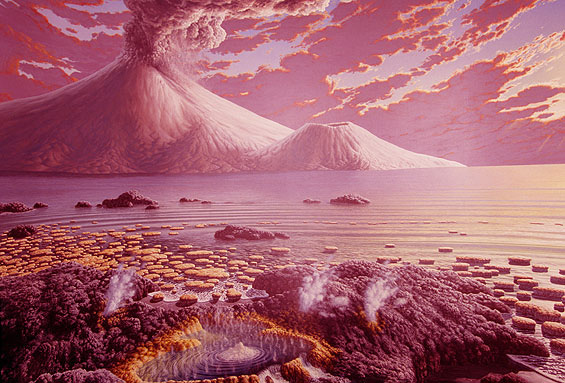
When the Earth formed, its atmosphere was very different from today. In fact, in the beginning it almost had no atmosphere at all. It took millions of years for the planet to cool down enough to start building up an atmosphere composed mainly by water vapour, carbon dioxide and nitrogen. Notice anything missing?

Exactly, no oxygen! The components of this early atmosphere came from the gases released from the molten rock. And one important detail: there was no life yet.

An early Earth may have looked like this. Peter Sawyer / Smithsonian Institution

The oxygen that is found in the atmosphere (O2) comes primarily from photosynthesis. The earliest evidence for life on Earth dates to about 1 billion years after the Earth formed. Early organisms were anaerobic, likely using methanogenesis or anoxygenic photosynthesis. Neither of these mechanisms release oxygen, but rather methane or sulphur components and water (Catling & Claire, 2005). The exact moment that oxygenic photosynthesis appeared is debated, especially considering that many fossils found are poorly preserved (Sessions et al., 2009). However, to get an idea, in fig. A there is a timescale showing the ages of fossils found, and possible moments when photosynthesis could have appeared, since cyanobacteria produce O2.

Fig. A: Timescale and ages of fossils. Sessions et al. (2009)


So what happened 2.4 billion years ago?


The oxygen levels in the atmosphere increased in what is known as the "Great Oxidation Event" (fig. B). The atmospheric oxygen went from 0.001% of present day levels to 5-18% by the time everything stabilised, some 1.8 billion years ago (Sessions et al., 2009). There was a second event that finally took the oxygen levels to present day levels about 500 million years ago.

Fig. B: A simplified view of the evolution of oxygen in the atmosphere. Sessions et al. (2009)
Now, cyanobacteria had already been doing photosynthesis and producing oxygen for some time (at least some 300 million years), but it wasn't building up in the atmosphere, at least not in the amounts shown by the geological records. This means that around this time there must have been a change: either there was an increase in the production of oxygen, or a change in the oxygen sinks to allow the O2 to remain in the atmosphere.  

One hypothesis relates the Great Oxidation Event with the changes in the tectonics of the planet that happened around the same time. Continental land masses stabilised towards the end of the Archaean (~2.5 billion years ago). Kump (2007) suggests that an increase in subaerial vulcanism is related with a reduced sink for oxygen, since before the emergence of continents most volcanic activity was submarine and more reducing (used up more oxygen). This is a compelling hypothesis because changes on the Earth of this scale (mayor continental change and substantial increase in atmospheric oxygen) happening at the same time are generally more than a simple coincidence. 

Why is this important?


Besides the fact that WE need oxygen to breathe, it is likely that complex multicellular life was able to evolve thanks to this: aerobic respiration is much more efficient than anaerobic fermentation (Sessions et al., 2009).

Catling & Claire (2005) also mention a couple of important things to consider:
  • An early ozone layer in the stratosphere emerged once there was enough oxygen in the atmosphere (approximately 0.1% present day levels).
  • Methane levels where high (simulations indicate 100 to 1000 times higher than present day), which kept the Earth warm, despite a "weaker" Sun. The rising atmospheric oxygen caused a reduction in methane, cooling the Earth down significantly, perhaps even causing  Snowball Earth conditions.  

This is only one of many mayor changes the Earth has gone through. In this case the intervention of newly appeared life played an important role in changing the atmosphere. However, as we will see in the next posts, one change can be followed by others that are unexpected.

------
Other bibliography:
Tarbuck, E. and Lutgens, F. (1997). Earth science. Upper Saddle River, NJ: Prentice Hall.